Lecture 2 Parallel Irreversible Reactions
2.1 Introduction
In many chemical systems, a single reactant can undergo multiple competing reactions simultaneously to form different products. These are called parallel reactions. The simplest example is where a reactant A can form either product B or product C:
\[\mathrm{A} \xrightarrow{k_1} \mathrm{B}\] \[\mathrm{A} \xrightarrow{k_2} \mathrm{C}\]
Understanding how these parallel reactions proceed and what controls their relative rates is crucial for many practical applications, particularly in synthetic chemistry where we often want to maximize the yield of one product over another.
2.2 Simple First-Order Reactions
Let us first consider the case of a single first-order reaction:
\[\mathrm{A} \xrightarrow{k} \mathrm{B}\]
The rate equations are:
\[\frac{\mathrm{d}[\mathrm{A}]}{\mathrm{d}t} = -k[\mathrm{A}]\] \[\frac{\mathrm{d}[\mathrm{B}]}{\mathrm{d}t} = +k[\mathrm{A}]\]
Integrating these gives: \[[\mathrm{A}] = [\mathrm{A}]_0\mathrm{e}^{-kt}\]
And since [B] = [A]0 - [A] (from conservation of mass): \[[\mathrm{B}] = [\mathrm{A}]_0(1-\mathrm{e}^{-kt})\]
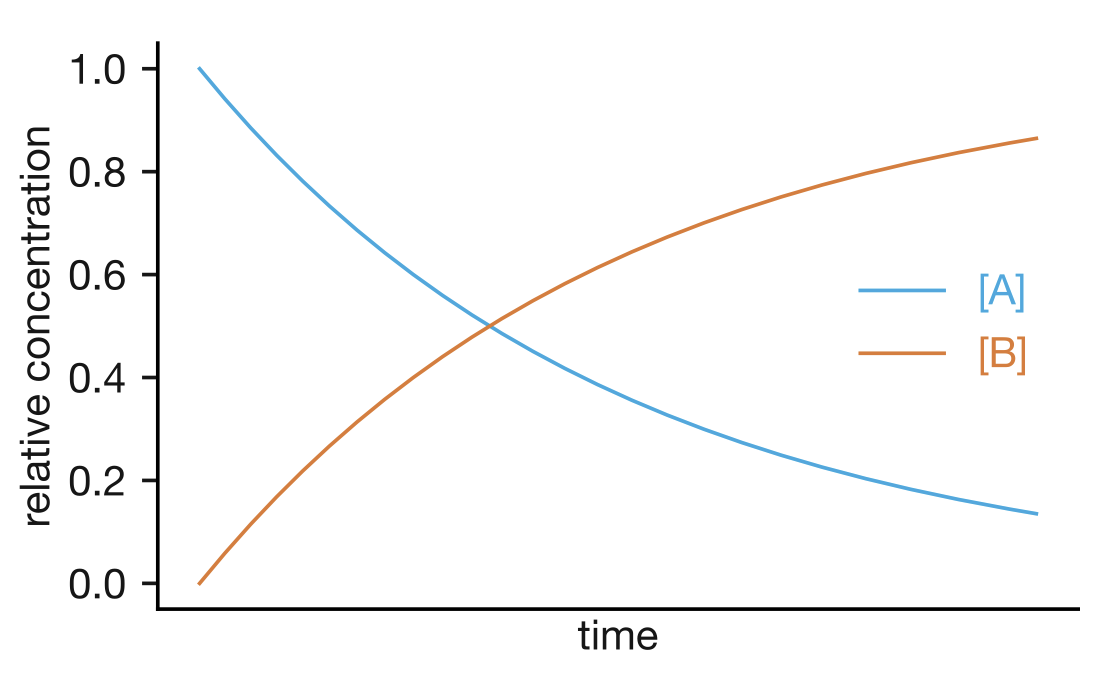
Figure 2.1: Concentrations of reactant, A, and product, B, as a function of time for a reaction \(\mathrm{A}\longrightarrow\mathrm{B}\) with first-order kinetics.
2.3 First-Order Parallel Reactions
For parallel reactions where both pathways are first-order:
\[\mathrm{A} \xrightarrow{k_1} \mathrm{B}\] \[\mathrm{A} \xrightarrow{k_2} \mathrm{C}\]
The rate of change of A is now:
\[\frac{\mathrm{d}[\mathrm{A}]}{\mathrm{d}t} = -(k_1 + k_2)[\mathrm{A}]\]
Integrating this gives:
\[[\mathrm{A}] = [\mathrm{A}]_0\mathrm{e}^{-(k_1+k_2)t}\]
For product B:
\[\frac{\mathrm{d}[\mathrm{B}]}{\mathrm{d}t} = k_1[\mathrm{A}] = k_1[\mathrm{A}]_0\mathrm{e}^{-(k_1+k_2)t}\]
Integrating:
\[[\mathrm{B}] = \frac{k_1}{k_1+k_2}[\mathrm{A}]_0(1-\mathrm{e}^{-(k_1+k_2)t})\]
Similarly for C:
\[[\mathrm{C}] = \frac{k_2}{k_1+k_2}[\mathrm{A}]_0(1-\mathrm{e}^{-(k_1+k_2)t})\]
2.4 Key Features of Parallel Reactions
Several important points emerge from these expressions:
The formation of both products B and C is controlled by the same overall rate constant (\(k_1 + k_2\))
The relative yields of products are determined by the ratio of the rate constants:
\[\frac{[\mathrm{B}]}{[\mathrm{C}]} = \frac{k_1}{k_2}\]
This ratio is often called the selectivity, S:
\[S = \frac{k_1}{k_2}\]
![B and C both form via first-order processes with the same effective rate constant $k_1+k_2$. At any point in time, the ratio $[\mathrm{B}]/[\mathrm{C}]$ is equal to $k_1/k_2$.](lecture_2/figures/parallel_reactions.png)
Figure 2.2: B and C both form via first-order processes with the same effective rate constant \(k_1+k_2\). At any point in time, the ratio \([\mathrm{B}]/[\mathrm{C}]\) is equal to \(k_1/k_2\).
2.5 Temperature Effects on Selectivity
How does changing temperature affect the selectivity? Using the Arrhenius equation:
\[k_1 = A_1\exp\left(-\frac{\Delta E_1}{RT}\right)\] \[k_2 = A_2\exp\left(-\frac{\Delta E_2}{RT}\right)\]
Therefore:
\[S = \frac{k_1}{k_2} = \frac{A_1}{A_2}\exp\left(-\frac{\Delta E_1-\Delta E_2}{RT}\right)\]
If \(\Delta E_1 > \Delta E_2\), then (\(\Delta E_1 - \Delta E_2\)) is positive, and increasing temperature will increase \(S\). This can be visualized using an Arrhenius plot (\(\ln k\) vs \(1/T\)), where the reaction with the higher activation energy has the steeper slope.
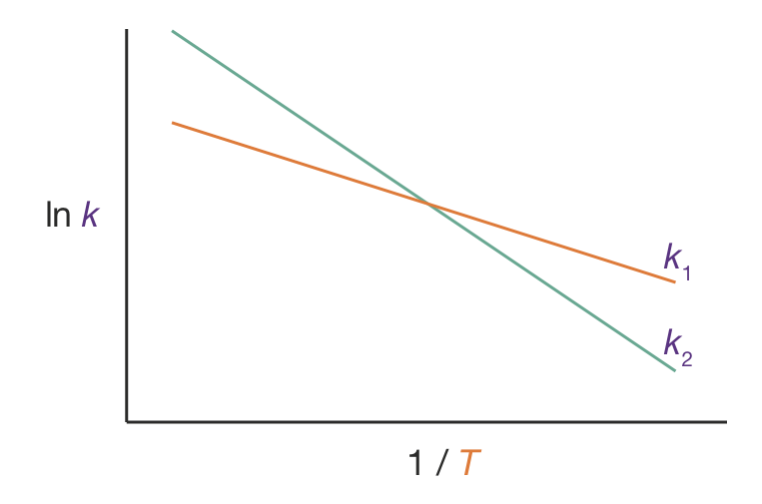
Figure 2.3: Arrhenius plot showing the qualitative effect of changing temperature on selectivity between two reactions with different activation energies. Increasing temperature gives a larger increase in rate constant for the reaction with the larger activation energy, \(\Delta E\), and increases selectivity for the product formed via this reaction.
2.6 Pressure Effects on Selectivity
The effect of pressure on selectivity depends on the molecularity of the competing reactions:
If both reactions have the same molecularity (e.g., both first-order), pressure has no effect on selectivity because k is independent of pressure.
For reactions with different molecularity:
\[\mathrm{A} \xrightarrow{k_1} \mathrm{B}\] \[2\mathrm{A} \xrightarrow{k_2} \mathrm{C}\]
The selectivity becomes pressure-dependent:
\[\frac{[\mathrm{B}]}{[\mathrm{C}]} = \frac{\text{rate}_\mathrm{B}}{\text{rate}_\mathrm{C}} = \frac{k_1[\mathrm{A}]}{k_2[\mathrm{A}]^2} = \frac{k_1}{k_2[\mathrm{A}]}\]
Following Le Chatelier’s principle, increasing pressure favors the reaction with the higher molecularity.
2.6.1 Example: Decomposition of H2O2
The decomposition of hydrogen peroxide in aqueous solution occurs through two parallel pathways. A unimolecular decomposition:
\[\begin{equation} \mathrm{H}_2\mathrm{O}_2 \overset{k_1}{\longrightarrow} \mathrm{H}_2\mathrm{O} + \frac{1}{2}\mathrm{O}_2 \end{equation}\]
and a bimolecular process:
\[\begin{equation} 2\mathrm{H}_2\mathrm{O}_2 \overset{k_2}{\longrightarrow} 2\mathrm{H}_2\mathrm{O} + \mathrm{O}_2 \end{equation}\]
The overall rate of H2O2 consumption combines both pathways:
\[\begin{equation} -\frac{\mathrm{d}[\mathrm{H}_2\mathrm{O}_2]}{\mathrm{d}t} = k_1[\mathrm{H}_2\mathrm{O}_2] + 2k_2[\mathrm{H}_2\mathrm{O}_2]^2 \end{equation}\]
The factor of 2 in the second term arises from the stoichiometry of the bimolecular process, where each reaction event consumes two H2O2 molecules.
The relative contribution of each pathway depends on the concentration of H2O2:
\[\begin{equation} \frac{\text{rate}_1}{\text{rate}_2} = \frac{k_1[\mathrm{H}_2\mathrm{O}_2]}{2k_2[\mathrm{H}_2\mathrm{O}_2]^2} = \frac{k_1}{2k_2[\mathrm{H}_2\mathrm{O}_2]} \end{equation}\]
This ratio varies inversely with H2O2 concentration. The relative importance of the two pathways therefore depends both on the concentration and on the specific values of the rate constants \(k_1\) and \(k_2\).